
Blog
Guides for calmer support and better documentation.
Practical guidance on knowledge bases, self-service support, and AI-searchable documentation—straight from the team building HelpSite.
Customers Are Churning at Onboarding. A Help Center Fixes It.
Most SaaS churn during onboarding happens when new customers get stuck and can't find help fast enough. A well-built self-service help center with AI-powered search closes that gap and gets customers to first value faster.
Done-For-You Help Center: How HelpSite Builds Yours
A proper help center is on almost every founder and support lead's list. It just never makes it to the top. HelpSite's Done-For-You service exists for exactly that team — you hand over your scattered docs, FAQs, and tribal knowledge, and a team of writers and knowledge base specialists builds a clean, AI-ready help center in 2 to 6 weeks. This post explains who it is for, how the four-step process works, what each package includes, and how to pick the right one for your situation.
Why Deflection Rate Is the Wrong Help Center Metric in 2026
Deflection rate counts support interactions that never reached a human—but an absence is not an outcome. A customer who asks your chatbot a question, gets nothing useful, and gives up is recorded as a successful deflection. There is no shared industry definition, so numbers from two vendors cannot be compared. This post explains why deflection misleads, offers four harder replacements (verified resolution rate, recontact rate, escalation quality, and cost per resolved interaction), shows what the major platforms actually report, and argues the cheapest improvement is reading the searches and chats your help center already recorded.
Turn Your Website, PDFs, and Docs Into an AI Knowledge Base
Most teams don't have a documentation problem — they have a documentation distribution problem. This post shows how to convert existing sources (website pages, PDFs, Google Drive, Notion, support emails) into a live AI-searchable knowledge base using HelpSite AI KB Generator in five steps, what patterns to avoid on the first run, and role-specific next actions for founders, support leads, product managers, and agencies.
How to Set Up an AI Chatbot on a Help Center in 30 Minutes
You can complete the hands-on setup for a source-backed AI chatbot in about 30 minutes if your knowledge base is already in reasonable shape. This guide walks through the five steps—enable and sync the chatbot, add optional instructions, test its source links with real customer questions, and review conversations each week—plus the prep that makes launch easier and the common mistakes to avoid.

Meet HelpSite's New AI Knowledge Base Tools
HelpSite just launched the AI KB Generator — build a full knowledge base from your existing documents, a website crawl, Google Drive, or a guided brief, all in one sitting. And if you'd rather not build it yourself, our new Done-for-You service will do it for you. Here's what's new and how to get started.
Should Your Help Center Publish an llms.txt File in 2026?
llms.txt is a markdown file that lists your key documentation so AI clients can find it without wading through page navigation. Adoption grew 8.8x in the year to May 2026, but 97% of published files received zero requests, and Google says its Search ignores them. The real payoff is narrow—coding agents and agentic browsers like Claude Code that read it to locate developer docs. If you want AI clients to reliably use your knowledge base, a served connection like an MCP server does far more than a static file. This post covers what llms.txt is, what the data actually shows, how AI clients reach your help center, and when publishing one is worth the hour.
AI Knowledge Base Software in 2026: 5 Features That Matter
The AI knowledge base category matured fast in 2026, and HelpSite ships five features that matter for it: AI Chatbot (source-backed answers from your published articles), Sourced AI Answers (surfaces the source article behind an AI answer), MCP Server (exposes your KB to Claude and other MCP-compatible clients), AI KB Generator (builds a knowledge base from documents, a website crawl, Google Drive, or a guided brief), and Themes (branded help centers with custom domain and full HTML/CSS control). This recap breaks down each feature, who it is for, and how HelpSite compares with Zendesk, Intercom, Notion, and Document360.
How to Make AI Chatbot Answers More Trustworthy
An AI chatbot only helps if people can trust what it says, and one confident wrong answer sends customers back to filing tickets. Trustworthy answers come from evidence people can check: responses grounded in content you actually published, with the source shown when one supports the answer. This post walks through a five-step process for making your AI chatbot's answers verifiable, then shows how HelpSite builds that in through two layers—AI Chatbot, the conversational surface, and Sourced AI Answers, the trust layer that links each answer back to a real article—including when each one matters more, from high-volume support questions to regulated industries where every claim needs to be checked.
AI Knowledge Base Generators: Faster Drafts, More Trust
Can AI draft your help articles? Yes, but only inside the right workflow. This post covers the three things AI does well (structuring messy notes, rewriting for tone, applying consistent structure at volume), the three it still gets wrong (product accuracy, current information, editorial judgment), a five-step hybrid workflow, a look at how the HelpSite AI KB Generator applies it, and the mistakes teams make in their first month.
Agency Playbook: Running Branded Client Portals with Themes
Agencies are one of the best-fit users of a modern knowledge base platform: every client needs a branded home for onboarding docs, playbooks, and shared resources. This playbook covers running one themed, custom-domain portal per client from a single HelpSite dashboard, adding a per-client AI chatbot, what a great portal includes, and three models for pricing it as an agency service.
The State of Self-Service Support in 2026: What Changed
Self-service support has shifted from a cost-cutting tactic to strategic infrastructure. This post covers the macro AI shift, what patterns are winning and losing in 2026, five defining trends (MCP, sourced answers, internal/external convergence, brand consistency, AI-era analytics), a 90-day action plan, and an FAQ on deflection, MCP timing, and the biggest mistake teams are making.
Internal vs External Knowledge Bases for the AI Era
The old internal-vs-external split is giving way to a hybrid model where one knowledge base serves both audiences with layered access controls. This post covers when to keep them separate, when to unify, how HelpSite Themes, AI Chatbot, and MCP Server make hybrid setups seamless, and a six-row decision framework table to help teams choose the right setup.
Introducing HelpSite Themes: Make Your Help Center Unmistakably Yours
HelpSite Themes gives teams four ready-made starting themes, no-code brand controls, and full HTML and CSS access on Gold and Plus plans. The post covers why branded help centers matter as a buying signal, an AI signal, and a trust signal — and walks through the four themes, customization layers, and use cases for agencies, multi-product SaaS, and teams running both internal and external sites.
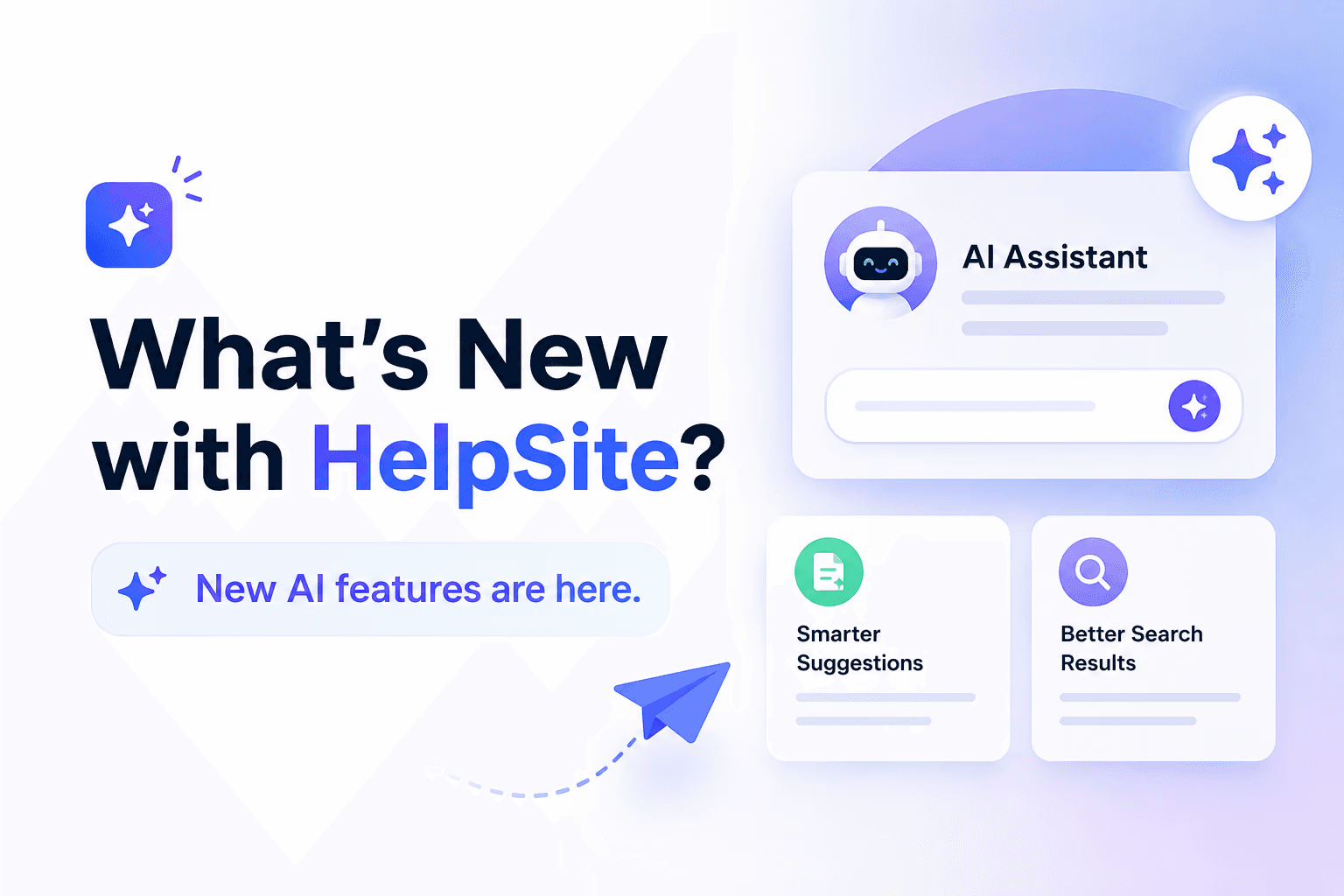
Meet HelpSite's New AI Features
HelpSite just shipped three features customers have been asking for: an AI Chatbot that answers questions directly from your knowledge base, an MCP Server that connects your docs to Claude and ChatGPT, and Custom Themes that let you match your help center to your brand — no code required.
The Math Behind MCP: Time Saved Across Your Team
HelpSite MCP Server connects AI tools to your live knowledge base so teams can search, draft, update, and audit documentation faster. This post compares the old workflow with MCP-assisted workflows for support, product, operations, and content teams, then shows readers how to calculate time savings from their own baseline.
5 Workflows You Can Unlock With HelpSite MCP Server
HelpSite MCP Server lets teams connect their HelpSite knowledge base to MCP-compatible AI clients like Claude, making it easier to search, draft, update, and organize help content from one place. The post highlights five key workflows, including answering customer questions, drafting new articles, bulk updating docs, auditing knowledge base structure, and powering internal AI assistants with current content.
Content Debt: When to Archive, Rewrite, or Leave Help Articles
This article explains how content debt builds up in a help center through stale, duplicate, and orphaned articles. It gives teams a simple triage framework for deciding when to archive, rewrite, or leave articles alone, plus a practical audit process they can run regularly. It also shows how HelpSite can help teams use analytics, assignments, and recurring reviews to keep documentation accurate without needing a major content sprint.
Help Center Analytics in the MCP Era: What to Measure Today
Help center analytics are changing because AI assistants can answer customer questions before users ever visit a help center page. The post explains that traditional metrics like search success, failed searches, article engagement, and deflection still matter, but teams also need to track AI citation accuracy, MCP tool-call patterns, chatbot escalations, and public AI citation share. It recommends a simple workflow: review failed searches, run quarterly AI accuracy checks, turn gaps into a content backlog, and track both old and new metrics together.
MCP and Knowledge Bases: What Support Teams Need in 2026
MCP is becoming a key way for AI assistants to connect to help centers, docs, and internal systems without needing one-off integrations. The article explains why this matters for support and ops teams, especially as AI tools increasingly rely on knowledge base content to answer customer and internal questions. It also introduces the upcoming HelpSite MCP Server, which will let MCP-compatible AI clients search, draft, update, and manage HelpSite content while respecting public and internal article controls.
Why Knowledge Bases Still Drive Growth in 2026
The article explains that knowledge bases remain essential in 2026 because they power support deflection, onboarding, sales, internal alignment, and AI accuracy. It highlights five business levers: reducing support costs, improving time to value, helping prospects self-verify, preserving internal knowledge, and grounding AI tools in trusted content. The main message is that teams should treat their knowledge base as core infrastructure, not just a support resource.
AI Help Center Guide: Prepare Before Users Notice
AI assistants now answer customer questions using your public docs, often before users visit your site, which means poorly structured content leads to wrong or vague answers. To fix this, teams should restructure help articles around clear questions, lead with direct answers, and simplify language so AI can extract accurate information. Small improvements to structure and clarity can boost accuracy across multiple channels, including chatbots, search, and public AI tools, without rewriting everything.

How to Use Your Support Ticket Data to Write Better Help Articles
Most teams build help content based on assumptions instead of real user questions, which leads to a disconnect between their knowledge base and support tickets. By treating tickets as a source of insight, teams can identify recurring issues, use real user language, and create articles that directly solve common problems. Over time, this approach reduces support workload by turning documentation into a continuously improving system driven by actual user needs.
Knowledge Base Metrics That Actually Reduce Support Tickets
This article explains which knowledge base metrics actually matter for reducing support tickets and proving ROI. It breaks down key KPIs like ticket-deflection rate, article effectiveness, and search success, and shows how to turn those insights into actionable improvements. You’ll also learn a simple optimization workflow and how tools like HelpSite’s analytics dashboard make tracking performance easier and more effective.
How Fintech Teams Manage Compliance in One Place
Fintech compliance is challenging due to complex, overlapping regulations and the need to consistently prove adherence through clear documentation and audit trails. Many teams struggle with scattered documentation across multiple tools, which slows audits, increases risk, and creates confusion around version control and access. To address this, leading fintech teams centralize documentation into a single, searchable system with clear ownership, version tracking, and regular reviews to stay audit-ready and efficient.
How IT Teams Scale Support Without Hiring More Staff
IT teams often struggle to keep up with growing support demands, leading to burnout and slower response times, but hiring more staff isn’t always the best solution. Instead, scaling support comes from turning repetitive questions into clear, accessible documentation and building a centralized knowledge base employees can use on their own. By focusing on self-service, standardizing guides, and continuously improving documentation, teams can reduce tickets and free up time for higher-impact work.
How Knowledge Bases Help Train AI Chatbots for Teams
AI chatbots often fail when they rely on generic internet knowledge instead of accurate company documentation, leading to incorrect answers and frustrated customers. A structured knowledge base allows chatbots to retrieve and summarize verified product information, improving accuracy and reducing support tickets. By turning support documentation into organized, searchable training data, companies can build reliable AI support systems that serve both customers and internal teams.
How Hospitals Deliver Patient Instructions Efficiently
Hospitals often rely on paper handouts and verbal explanations during discharge, but patients frequently forget key details once they return home. Many healthcare teams are improving this by publishing clear, searchable digital care instructions that patients can access anytime. This approach helps reduce staff phone calls, improves treatment adherence, and makes recovery guidance easier for patients to follow.
How Clinics Reduce Front Desk Overload With Self-Service
Clinics often face front desk overload not from complex medical issues, but from high volumes of repetitive logistical questions about hours, insurance, forms, and appointment prep. By launching a simple, searchable knowledge base with clear patient FAQs and internal SOPs, clinics can deflect routine calls, standardize answers, and reduce workflow interruptions without heavy IT lift. The result is fewer repetitive calls, more consistent information, faster staff onboarding, and more time for teams to focus on patient care instead of acting as a call center.
How agencies centralize client resources in one portal
Agencies often waste billable hours answering repeat questions and digging through scattered docs across Slack, Drive, and email. By centralizing client resources into a single, searchable, branded portal, agencies reduce repetitive emails, speed up onboarding, and create a smoother client experience. With the right structure and lightweight tools, a client portal becomes a scalable system that protects margins while keeping communication clear and efficient.
How a Knowledge Base Routes Patients to the Right Care
A patient knowledge base helps people find the right department before they ever call, reducing misrouted inquiries, repeat transfers, and staff burnout. By offering clear, searchable answers in plain language, it routes common questions like billing, scheduling, and records directly to the correct team, which shortens call times and improves the patient experience. When structured around patient problems rather than internal departments, a simple knowledge base acts like a digital front desk that guides patients quickly and keeps healthcare operations running smoothly.
Common problems with IT documentation sites
Most IT documentation starts helpful, then quietly breaks as tools, teams, and processes change without updates. This piece explains why docs go stale, hard to scan, hard to trust, and how that leads people back to Slack and tickets even when answers exist. It also lays out clear, practical fixes so documentation stays useful, trusted, and worth maintaining as teams grow.
How to Write Documentation for Non-Technical Users
This guide explains how to write documentation that helps non-technical users complete tasks without needing to understand how the product works behind the scenes. It focuses on clear language, task-based structure, step-by-step instructions, and visuals to reduce confusion and support tickets. The takeaway is simple, good documentation starts with the user’s goal, answers “what do I do next,” and is reviewed often to stay clear and useful.
How to Eliminate Knowledge Silos in Customer Support
Support teams repeat the same answers when knowledge is scattered across Slack, tickets, personal notes, and outdated docs, creating silos that slow response times and frustrate both customers and agents. As SaaS products grow, these silos lead to inconsistent support, agent burnout, and painful scaling because key information stays trapped in people’s heads. The guide explains how to fix this by centralizing high-value answers in one searchable knowledge base, capturing documentation in the moment, and making it easy for agents to reuse and link to existing articles instead of rewriting explanations.
Speed up support onboarding with better documentation
Documentation helps support teams onboard new hires faster by replacing scattered docs, Slack answers, and tribal knowledge with a clear, searchable source of truth. With strong onboarding docs, new agents ramp quicker, handle tickets sooner, and gain confidence through real examples, tone guidance, and decision trees for edge cases. It also protects senior agents from constant interruptions, and when paired with AI-assisted drafting, teams can keep documentation fresh and scalable without adding headcount.
Customer Support Process Mapping: A practical guide
Process mapping helps customer support teams turn messy, inconsistent workflows into clear, repeatable systems that scale. This guide shows how to map support processes step by step, transform them into usable documentation with AI-assisted workflows, and keep knowledge up to date without adding headcount. You’ll also see how the right knowledge base turns process clarity into faster resolutions and stronger self-service.
How onboarding docs improve SaaS activation rates
Onboarding docs are often the hidden bottleneck in SaaS activation, causing users to stall or churn before experiencing real value. When treated as a core part of the product—task-based, modular, and paired with efficient AI-driven content workflows—documentation can significantly shorten time to first value and reduce support load. High-performing teams use onboarding docs as reusable activation assets that scale across users, channels, and product updates.
High-performing help centers and what you can learn
Most SaaS help centers fall behind because content grows faster than the process supporting it, leading to outdated articles, weak search, and rising support load. High-performing help centers focus on search-first structure, clear ownership, regular audits, and careful use of AI to speed drafts without sacrificing accuracy. Over time, audits improve not just support but onboarding, product clarity, and customer understanding.
30-Minute Knowledge Base Audit: Spot Gaps Fast
A quick monthly audit helps SaaS teams keep documentation current without slowing product work. By checking top articles, search behavior, UI accuracy, and missing steps, teams catch friction before customers hit it. This simple 30-minute habit reduces repeat questions, boosts self-serve success, and keeps support, product, and marketing aligned.
Which to Choose: Knowledge Base vs Help Center vs FAQ
Cut down on repeat support tickets with the right self-service tools. This guide breaks down the difference between knowledge bases, help centers, and FAQ pages—plus how to use all three together. HelpSite makes it easy to launch them from one no-code dashboard, all while following Google’s 2024 helpful content best practices.

How to Keep Docs High Quality in Fast Release Cycles
Fast release cycles often push documentation to the back seat, leaving teams with scattered notes, inconsistent articles, and rising support volume. This guide explains why documentation breaks under rapid shipping and lays out clear workflows, ownership structures, and lightweight tools to keep content accurate and aligned. It also shows how AI, simple processes, and regular audits help teams maintain a trustworthy help center even when the product changes every week.
Build a Single Source of Truth: Remote Team Knowledge Management
Remote teams often struggle with scattered information, leading to repeated questions, slow onboarding, and inconsistent workflows. A centralized, searchable knowledge base—built with simple processes like templates, ownership, and regular reviews—helps teams stay aligned, reduce errors, and find answers quickly. HelpSite enables remote teams to build this single source of truth with fast search, easy setup, and multi-site flexibility, improving both internal efficiency and customer support.
Documentation Tactics That Help Lower SaaS Customer Churn
Strong documentation cuts churn by helping customers solve problems fast and reach value sooner. AI-driven workflows make it easier to keep articles accurate, clear, and updated without adding more staff. With a platform like HelpSite, SaaS teams can maintain reliable, easy to search content that lowers support load and keeps users satisfied.
AI Prompts for SaaS: Scale Content Quality Fast
This guide shows SaaS teams how to use structured AI prompts to speed up content creation without losing quality or accuracy. It explains how to build a simple workflow for drafting, reviewing, and publishing using tools like HelpSite, plus prompt frameworks for both support docs and internal process notes. It also covers common mistakes, how to avoid them, and how AI can help small teams keep documentation current with less effort.
Knowledge Base Software: Why a Custom Domain Matters
A custom domain for your knowledge base strengthens trust, keeps your help center visually aligned with your brand, and improves the user experience. It also boosts SEO by keeping search traffic, backlinks, and authority on your own domain instead of your vendor’s. HelpSite makes this possible quickly, even on the free plan, with features like branded design, fast search, and smart contact forms.
Help Center SEO: Optimize Articles for Google & Users
A well-optimized help center reduces tickets and boosts search visibility. By using clear structure, internal links, and fresh content, your support articles can rank in Google and actually help users. You don’t need to be an SEO expert—just apply a few best practices to make every article easier to find and use.
The 3-Minute Knowledge Base Audit: Is Yours Helping or Hurting?
Most knowledge bases aren’t broken because of bad content. They’re broken because no one checks if they still work. This post breaks down a simple 3-minute audit that helps you see whether your help center is actually reducing tickets—or quietly adding more. It shows how quick checks on search, content freshness, and deflection can reveal where self-service is failing and how to fix it fast, without rebuilding everything.
AI Writing Prompts for SaaS Content: How to Scale Quality Without Losing Your Voice
SaaS teams can scale content production without losing their brand voice by using reusable AI writing prompts that define intent, tone, and structure. The article explains how to build “super-prompts,” store them in HelpSite for easy reuse, and use them to speed up workflows while keeping content consistent and human.
Showing 49 of 72