

Every few months, someone declares the help center dead.
First it was chat. Then in-app product tours. Then AI assistants that would answer every question before a customer ever opened your docs. Each wave promised to make the traditional knowledge base obsolete.
None of them did. The knowledge base is still doing the work. It quietly powers deflection, onboarding, sales conversations, internal alignment, and the AI tools that were supposed to replace it. The teams winning in 2026 aren't the ones who picked the shiniest tool. They're the ones who treated their knowledge base as core infrastructure and let every new channel plug into it.
The fundamentals didn't change, the surface did
How customers reach your documentation has shifted dramatically. They ask ChatGPT before they search Google. They use an in-app AI chatbot before they open the help center. They expect an answer in a sentence, not a scroll. Our piece on how AI is reshaping the help center walks through that surface change in detail.
What customers actually need hasn't changed at all. They want an accurate, specific, trustworthy answer. That answer has to exist somewhere, written and maintained, before any tool can deliver it. Your knowledge base is that somewhere. Every channel layered on top of it (search, chat, AI, sales decks, internal training) is a delivery mechanism for content the knowledge base owns.
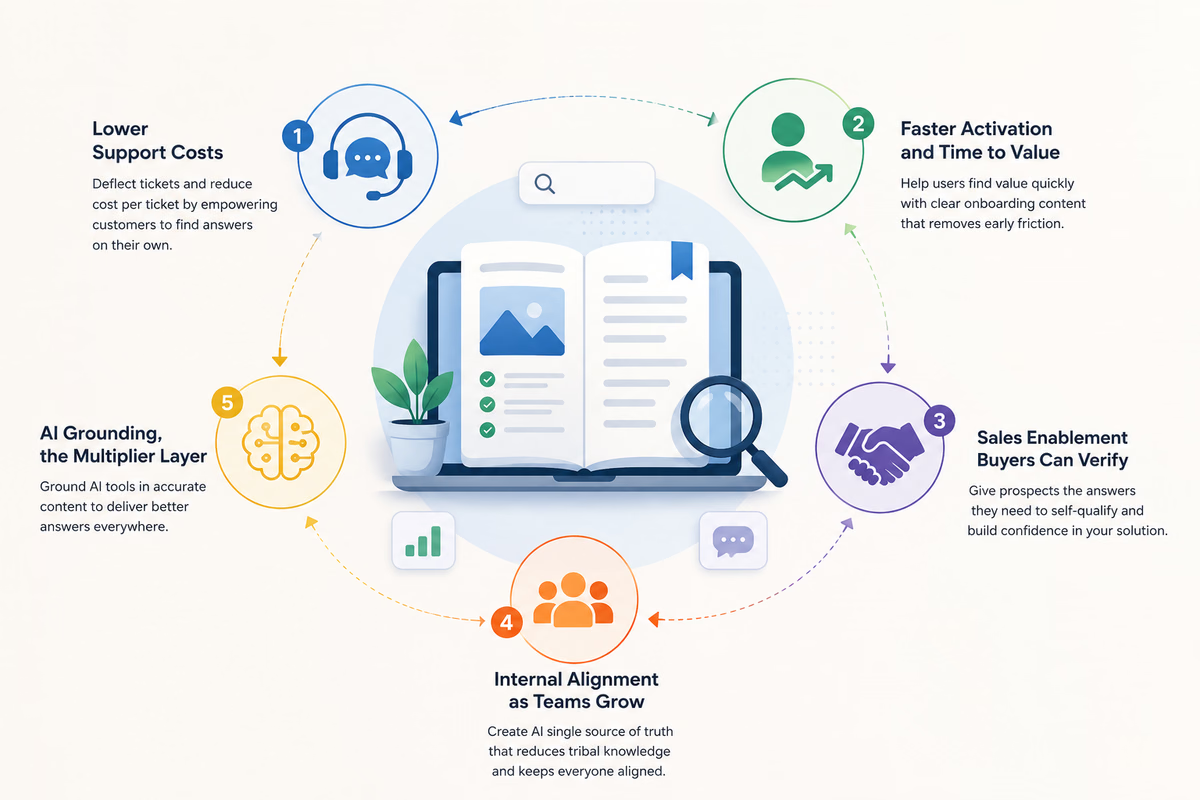
Lever 1: Lower support costs that scale with the product, not the team
This is the oldest reason a knowledge base exists, and it still pays for the platform.
When a clear, searchable article answers a question, you don't pay an agent to answer it. You don't pay for the back and forth. As we covered in knowledge base metrics that actually reduce support tickets, even a modest lift in deflection rate translates into real headcount savings.
What's different in 2026 is the leverage. A good article doesn't just deflect the ticket it was written for. It feeds your AI chatbot, your public LLM answers, and your in-app help. One article can deflect the same question across four surfaces.
We use HelpSite as our knowledge base for internal and external purposes, and we have effectively reduced our support cases by roughly 30% in the first year in UK.
Lisa J., Head of Training, IT Services
Lever 2: Faster activation and time to value
Most SaaS churn happens before the customer ever files a support ticket. They sign up, hit a wall in the first ten minutes, and quietly never come back.
Onboarding documentation is the cheapest activation lever you have. A clear getting started article that answers the first question a new user actually asks pulls them across the activation line faster than any in-app tour. We broke this down in how onboarding docs improve SaaS activation rates. When docs are treated as part of the product, time to first value drops measurably.
Lever 3: Sales enablement that prospects can verify themselves
Modern B2B buyers don't wait for the sales call to evaluate your product. They Google "does [your product] integrate with Salesforce." They ask ChatGPT what your tiers include. They check your SOC 2 documentation before they ever book a demo.
Every one of those answers comes from your public knowledge base. If the answer is clear, the buyer self qualifies and shows up to the call ready to talk pricing. If the answer is missing, the buyer bounces or arrives with the wrong impression. This is especially true in fintech and healthcare, where documentation IS the credibility signal.
📘 Free download: The 2026 Knowledge Base Growth Playbook
The full 18-page playbook that expands every lever in this post. Worked deflection math, a tribal-knowledge-tax calculator, a printable 5-lever audit scorecard, and a 30/60/90 day rollout plan. Built for SaaS, support, IT, and ops teams.
👉 Grab the playbook below! Input your email to get your copy. FOR FREE
Knowledge Base Growth Playbook Email Submit
Lever 4: Internal alignment as the team grows
Knowledge bases aren't just customer facing. The same structural discipline that makes a public article AI readable makes an internal SOP usable by a new hire on their second day.
When the product ships every week, tribal knowledge becomes expensive. A senior engineer answering the same Slack question seven times a month is a tax that scales with headcount. We wrote about this in how to eliminate knowledge silos and speeding up support onboarding. The fix is structural: capture the answer once, in a searchable place, and stop paying the re-explanation tax.
My team uses HelpSite to write SOPs and all of our calling and chat agents swear by it. This has helped boost productivity by 2x as agents can directly copy and paste instead of typing.
Diptankar B., Manager, Customer Experience, IT Services
Lever 5: AI grounding, the new layer that multiplies the others
AI fits in as a multiplier, not as a replacement.
An AI assistant (public or embedded) can only be as good as the content it can read. A clean, structured knowledge base lets an AI quote your product accurately. A stale one produces vague answers and the kind of hallucinations we covered in the AI help center guide.
The teams getting AI right are not the teams with the fanciest chatbot vendor. They're the teams whose docs were already structured, current, and answer led when the chatbot was switched on.
I used HelpSite for a while and then tried an AI chatbot on my clients. I was very dissatisfied with that and realized most of my clients preferred the HelpSite implementation, so I returned to their service.
Arthur D., Owner, IT Services
Why this compounds, and why it's hard to copy
The five levers above don't run in parallel. They overlap. Every well written article is a deflection asset, an activation asset, a sales asset, an internal training asset, and an AI grounding asset, all at once.
A competitor can buy the same AI chatbot, run the same ads, ship the same feature. They can't replicate two years of disciplined documentation work in a quarter. That's the moat, and it's quietly getting wider.
How HelpSite supports the five levers
HelpSite is built around the patterns above. Lightning fast search makes the help center usable for deflection. Multiple sites lets you run customer facing and internal knowledge from one platform. Analytics shows which articles move the needle. The smart AI knowledge base keeps content structured for both humans and AI tools.
Powerful tool to reduce OPS overheads, easy to maintain, useful internal help site to capture organizational knowledge. Very easy to use, can have completely non technical people use it.
Francois R., COO, IT Services
Frequently asked questions
Isn't a help center just a support tool?
That's the framing that leaves help centers underfunded. The same content also drives activation, supports sales, trains internal teams, and grounds AI tools.
Will AI assistants replace the public help center?
For specific factual questions, AI is already the default for many users. For exploratory browsing, troubleshooting, and credibility checks, traditional help centers still win. See knowledge base vs. help center vs. FAQ.
How do we know if our knowledge base is pulling its weight?
Measure deflection rate, search success rate, and article engagement. Then look outside support: time to activation, sales call talk time on basic product questions, and Slack threads where the same question keeps reappearing.
Do we need a separate AI strategy on top of our help center?
No. One well structured knowledge base that AI tools can read cleanly is faster. The AI help center guide covers the structural changes.
Final thoughts
The story keeps changing. Chat, in-app tours, AI assistants, agents. The underlying truth doesn't. Customers, prospects, and internal teams need accurate, current answers. The knowledge base is where those answers live.
Pick the lever your team is losing the most money on right now. Make one structural change this week. The compounding starts the moment you stop treating your help center as a cost and start treating it as infrastructure.
Ready to turn your knowledge base into a real growth lever? Start your free HelpSite trial. No credit card required.