No generic training-data answers
Responses are grounded in your HelpSite articles, not a broad model memory that may not know your product or policies.

AI answers
Most AI chatbots fail when they answer from vague training data or stale snippets. HelpSite answers from your own knowledge base and points customers back to the article behind the response.


Trust first
The problem is not that customers dislike chat. The problem is that a wrong answer from a confident bot breaks trust fast.
Responses are grounded in your HelpSite articles, not a broad model memory that may not know your product or policies.
Each answer can point back to the article it came from, so customers can verify details instead of taking the chatbot's word for it.
When an article changes, the approved knowledge base becomes the place to improve future answers.
When a question needs judgment, policy review, or personal account help, your team still handles the conversation.
Common questions
Use the chatbot for the repeat questions already taking time from your support queue.
How do I upgrade my plan? Can I switch to annual billing? When does my renewal happen?
Can I use my own domain? How do I connect a custom URL to my help center?
How do I embed the help center widget on my website or inside my product?
What is the refund policy? Can I cancel my subscription before the billing date?
Chat history
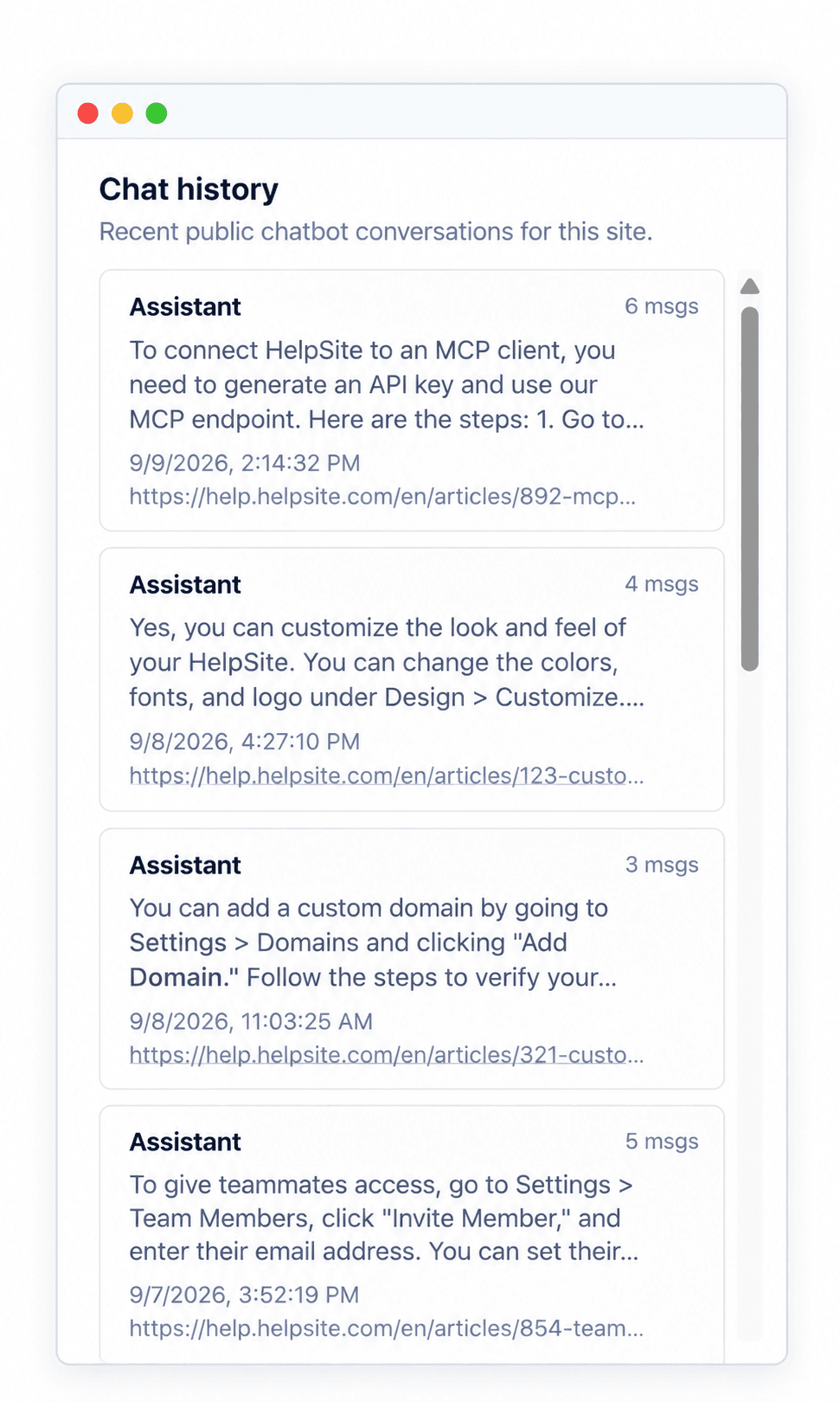
If the chatbot gives a weak answer, the fix should not be hidden. Chat history helps you trace what happened and improve the source content.
Pull up the exact chat, trace the answer back to the article, and fix the source before the same issue repeats.
Questions the chatbot cannot answer reveal which article your customers needed but could not find.
Use real customer wording to rewrite titles, expand instructions, and make articles easier to search.
Content gaps
A chatbot is only as good as the articles behind it. HelpSite turns unclear answers into a practical content backlog.
See which topics customers ask about again and again, then strengthen the articles that should answer them.
When the chatbot cannot answer well, that is a signal to write or expand a specific article.
Use customer phrasing from chats to improve article titles, headings, and search terms.
Start with a knowledge base your chatbot can trust, then use real chats to keep improving the articles behind it.
Common questions about using an AI chatbot with your HelpSite knowledge base.
HelpSite's AI chatbot answers from your published knowledge base articles instead of relying on generic model memory. That helps reduce hallucinated answers, gives customers a source link for verification, and makes the article behind each response easier for your team to improve.
No AI system can guarantee perfect answers, so HelpSite focuses on source-grounded responses and reviewable chat history. If content is missing, stale, or unclear, your team can trace the weak answer back to the source article and improve the knowledge base.
Yes. Chat history gives your team visibility into customer questions, confusing answers, and missing documentation. Those conversations become a practical list of articles to improve or create next, using the same wording customers actually typed.
No. The chatbot helps with repeat questions by using your articles, but your team still owns complex issues, policy judgment, account-specific help, and content quality. Think of it as a better first answer, not a support replacement.
AI workflows
Connect HelpSite to MCP-compatible AI tools so your team can search, draft, update, and organize docs faster.

Maintenance
See which articles work, what visitors search for, and where stale content is starting to create confusion.

One place for answers
Create public articles, private SOPs, and team playbooks in a simple editor built for repeated questions.
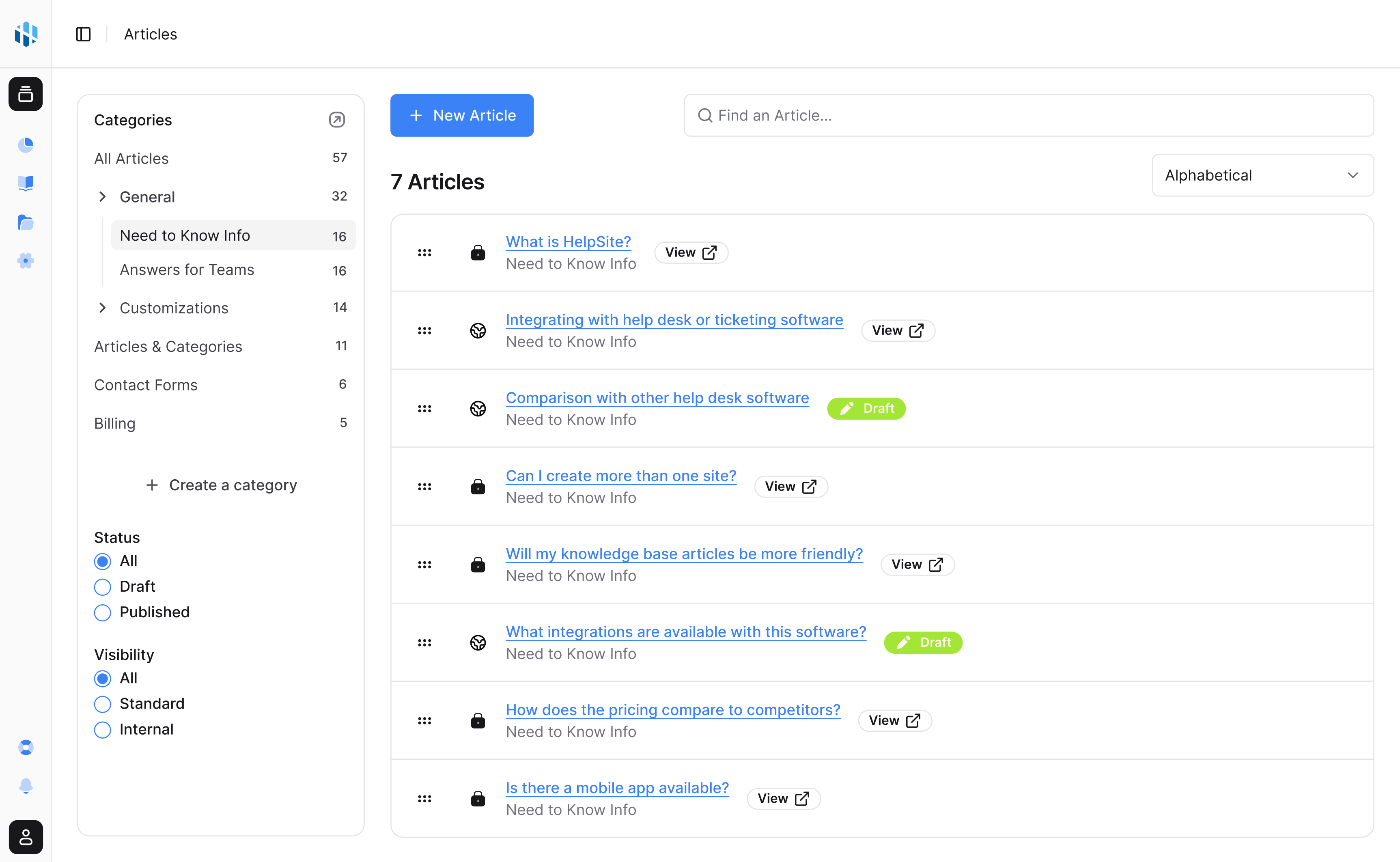
Launch a public help center, private SOPs, or both in an afternoon.
Start your free trial14-day free trial · No credit card to start