

Self-service support used to be a cost-cutting play. A help center existed so support teams could deflect the questions they did not want to answer. That framing is dead.
In 2026, self-service is where buyers self-qualify, where AI assistants ground their answers about your product, where internal teams onboard themselves, and where the first impression of "does this company operate well" gets formed. That makes it strategic infrastructure.
This is our snapshot of where the industry sits now, what shifted this year, and what the teams pulling ahead are doing differently.
The macro shift: AI is the front door
The single biggest change is that AI assistants are now the front door to your product for a growing share of customers.
Buyers ask ChatGPT and Claude how your product handles their edge case before they ever visit your site. Existing customers ask their in-app AI chatbot before they open the help center. Support agents use AI copilots to draft responses. Public LLMs summarize product documentation directly in search results, often before the user clicks anything.
The old model — customer types query, scans results, clicks the article — still works, but it is now one path among four or five. Your content has to work across all of them, or it fails in the ones you cannot see.
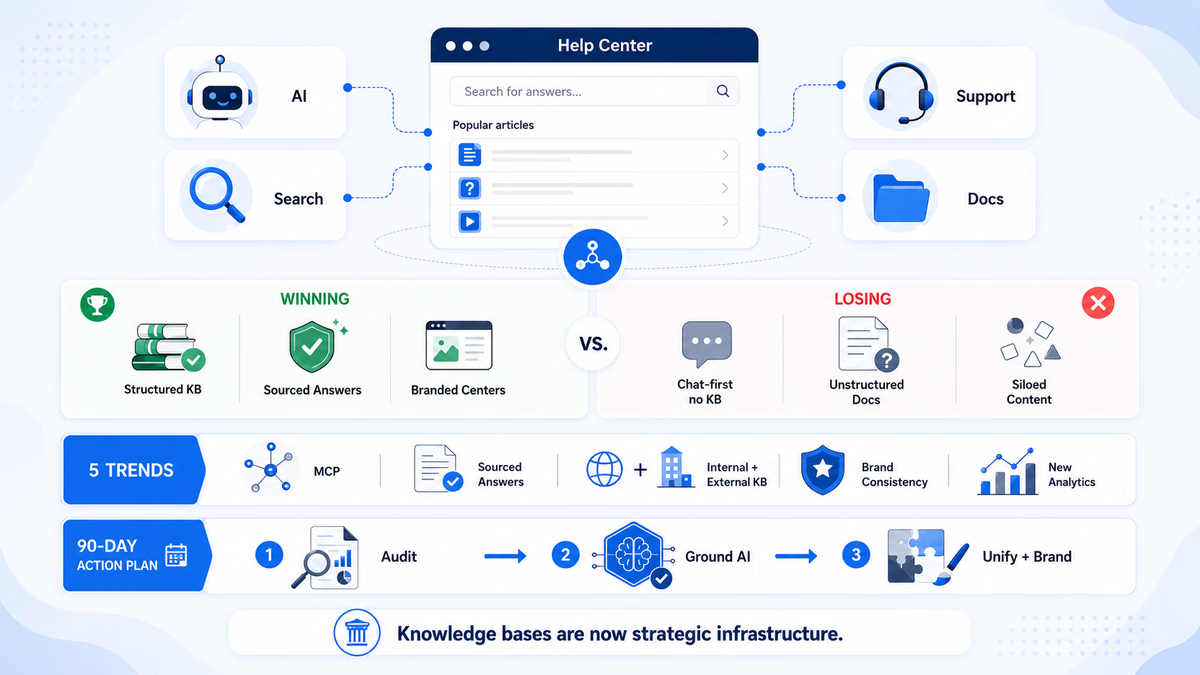
What is winning and what is losing in 2026
Three patterns are clearly winning:
Structured knowledge bases with clear ownership. Question-led titles, lead-with-the-answer paragraphs, defined product terms, quarterly audits. The teams that invested in structure over the last two years are the ones whose AI chatbots work, whose public LLM answers are accurate, and whose deflection rates are actually moving. Our AI Help Center Guide walks through the specific structural moves.
Source-backed AI answers. Buyers no longer trust black-box chatbots. Answers that show the source article behind them are winning trust while pure generative answers are quietly eroding it. Sourced AI Answers has become an expectation rather than a differentiator.
Brand consistency across every touchpoint. Help centers that match the product visually, on custom domains, with polished themes. The days of the "generic support portal" look are ending.
Three patterns are clearly losing:
Chat-first support with no underlying knowledge base. Chatbots without structured content behind them hallucinate, escalate everything, or refuse. Volume goes up. Trust goes down. Gartner found that the most common reason self-service fails, in 43% of cases, is that customers can't find content relevant to their issue.
Unstructured, feature-organized docs. Articles titled "Team management settings" instead of "How do I add a teammate" no longer rank, no longer get quoted by AI, and no longer serve users who search by question.
Siloed internal versus external content. Teams running two platforms for internal and customer docs are paying twice for tooling, splitting analytics, and creating version drift the moment product changes.
Easy to use. Perfect solution for our needs. Excellent CS. Stakeholders using the service cannot fault.
Kris B., Commercial Analyst, Sports
The five trends defining 2026
1. MCP is becoming the standard AI integration layer.
Model Context Protocol is doing for AI-to-data connections what USB did for hardware. Purpose-built AI clients (Claude Desktop, Claude Code, and a growing ecosystem) can now query your knowledge base directly through a shared protocol. HelpSite MCP Server is one implementation. Every serious knowledge base platform is either shipping an MCP server this year or will be behind by next.
2. Sourced answers are replacing black-box chatbots.
The "confidently wrong" AI chatbot is losing to source-backed alternatives that show the article behind every answer. Buyers, support leaders, and end users all agree: a chatbot that cites its work is trustworthy, one that does not is dangerous. HelpSite AI Chatbot is designed around this expectation from the ground up.
3. Internal and external knowledge bases are converging.
The wall between "customer docs" and "internal SOPs" is turning into an access control layer on top of a single well-structured knowledge base. Same platform, same backend, different permissions. The alternative — two platforms, two sets of analytics, two brand systems — is quietly becoming unaffordable. Our internal vs external knowledge bases post covers the decision framework.
4. Brand consistency is now a trust signal.
A generic-looking help center is now read as "this team takes shortcuts." Polished, branded, on-your-own-domain help centers are winning both buyer trust and AI citation share. The new HelpSite Themes release captures this shift: fast to launch, deep to customize, brand-consistent across every site an account manages.
5. Analytics is catching up to the AI era.
The old dashboard — page views, searches, bounce rate — is not wrong, just incomplete. The teams pulling ahead are tracking AI citation accuracy, failed-search patterns, chatbot escalation rates, and MCP tool-call data alongside the traditional signals. Our knowledge base metrics post covers the classic layer. The MCP-era metrics build on top.
Essential for providing a resource to our customers.
Ping K., Customer Success Manager, Biotechnology
What to do about it in the next 90 days
An honest gut-check against the trends above:
Days 1 to 30. Structural audit. Pick your top 20 articles by traffic. Rewrite each so the title is a literal question and the first sentence is the direct answer. Kill orphan articles, consolidate duplicates. Our 30-minute knowledge base audit gives you the cadence.
Days 31 to 60. AI grounding pass. Run the AI hallucinations audit once. Ask the top 10 support questions to three public AI assistants. Note where they fail. Fix the underlying articles. Turn on Sourced AI Answers if you have not.
Days 61 to 90. Unify and brand. If you are running separate platforms for internal and external content, consolidate. Apply a theme that matches your product. Move to your own custom domain. Add the six B2B-security must-have articles if you sell into regulated buyers.
Ninety days from now, the trend line on your search success rate, deflection rate, and AI citation accuracy will be measurably different.
Frequently asked questions
Is AI chatbot volume actually replacing help center traffic?
For specific factual questions, yes. For exploratory browsing, comparison shopping, and troubleshooting flows, traditional help center traffic is still growing. Optimize for both. Neither is going away.
Do we need to be on the MCP standard now or can we wait?
Waiting is a defensible position for one more quarter, no more. By the end of 2026, any serious enterprise buyer will be asking whether your knowledge base can plug into their AI stack through MCP. Building the structure now costs nothing extra and makes the eventual switch trivial.
What is the single highest-leverage move a team should make this quarter?
Rewrite the titles and first sentences of your top 20 articles as literal questions and direct answers. That one change moves search success, AI accuracy, and buyer credibility at the same time.
How is deflection changing as AI answers questions upstream?
Deflection is shifting from "self-serve on your site" to "self-serve wherever the user asked." The metrics have to expand. Watch traditional deflection, AI accuracy, and failed searches together to see the whole picture.
What is the biggest mistake teams are making in 2026?
Treating the help center as a support cost line item rather than infrastructure that pays back across support, sales, activation, and internal teams. The teams that fix this framing win the next two years.
Final thoughts
Self-service is now where your product gets explained, evaluated, sold, onboarded, and grounded across every AI surface your customers touch.
The teams that treat their knowledge base as infrastructure will spend the next twelve months compounding. The teams that treat it as an afterthought will spend those months explaining to their CFO why their support tickets are not going down.
Pick a trend. Make one structural move against it this week. That is how the compounding starts.