

The short answer
- llms.txt is a markdown file at your site root listing your key documentation so AI clients can find it without wading through page navigation (specification).
- Adoption grew 8.8x in the year to May 2026, reaching roughly 36,000 files (Originality.ai) — but 97% of those files received zero requests that month, and dedicated AI retrieval bots were about 1% of the requests that did arrive (Ahrefs).
- Google says Search ignores these files, and having one neither helps nor hurts rankings (Google, June 2026).
- Where it earns its keep is coding agents and agentic browsers — tools like Claude Code and Cursor that read it to locate your docs.
- If you want AI clients to reliably use your knowledge base, a served connection such as an MCP server does more than a static file. Publish llms.txt anyway if it is cheap, but do not expect traffic from it.
The problem: your docs now have two audiences
For twenty years, documentation was written for one reader: a person with a browser. That has changed. A meaningful share of the questions about your product are now asked to an assistant rather than typed into your help center search bar. The assistant answers from whatever it can reach, and if it cannot reach your documentation cleanly, it answers from something else. That something else might be a three-year-old forum thread.
So teams ask a reasonable question: is there a file we can publish that tells AI systems where our real documentation lives? There is. Whether it works is a separate question.
What is llms.txt?
A markdown file placed at /llms.txt (or a subpath like /docs/llms.txt) that gives AI clients a concise, curated index of your documentation. It uses an H1 title, a short blockquote summary, and H2 sections listing markdown links to your key pages.
The proposal was created by Jeremy Howard in 2024 and reached a second version in 2026. The reasoning is sound: web pages are built for humans, wrapped in navigation, banners, and interface furniture that wastes an AI client's limited context. A curated markdown index strips that away. Several major AI labs publish llms.txt for their developer documentation, and Chrome's Lighthouse now audits for it.
Does llms.txt actually work?
This is where the honest answer gets uncomfortable.
Research from Originality.ai tracking over 3 million websites found llms.txt instances grew 8.8x in the twelve months to May 2026, reaching roughly 36,000 files. Server-log research from Ahrefs covering 137,000 domains found that 97% of those files received zero requests in May 2026.
The requests that did arrive came mostly from tools checking whether the file exists — not from AI systems reading it:
| Requester type | Share of llms.txt requests |
|---|---|
| SEO audit tools | 21% |
| Unidentified bots | 14% |
| General web crawlers | 13% |
| Tech-profiling tools | 11% |
| Coding agents | 10% |
| AI retrieval bots (ChatGPT, Perplexity) | 1% |
AI bots across all categories made up about 19% of requests — but the dedicated retrieval bots that answer customer questions were just 1%. The file is read mostly by the tools that audit whether you have the file. (Figures from Ahrefs, reported June 2026.)
What does Google say about llms.txt?
Google has been direct. Its guidance, updated in June 2026, says maintaining these files "won't harm (nor help) your visibility or rankings in Google Search, as Google Search ignores them." Gary Illyes said in 2025 that Google does not support llms.txt and has no plans to, and John Mueller compared it to the old keywords meta tag: a file in which a site declares its own purpose, with nothing verifying the claim.
Treat any pitch selling llms.txt as an SEO or AI Overviews ranking factor with suspicion. It is not one.
Where llms.txt genuinely helps
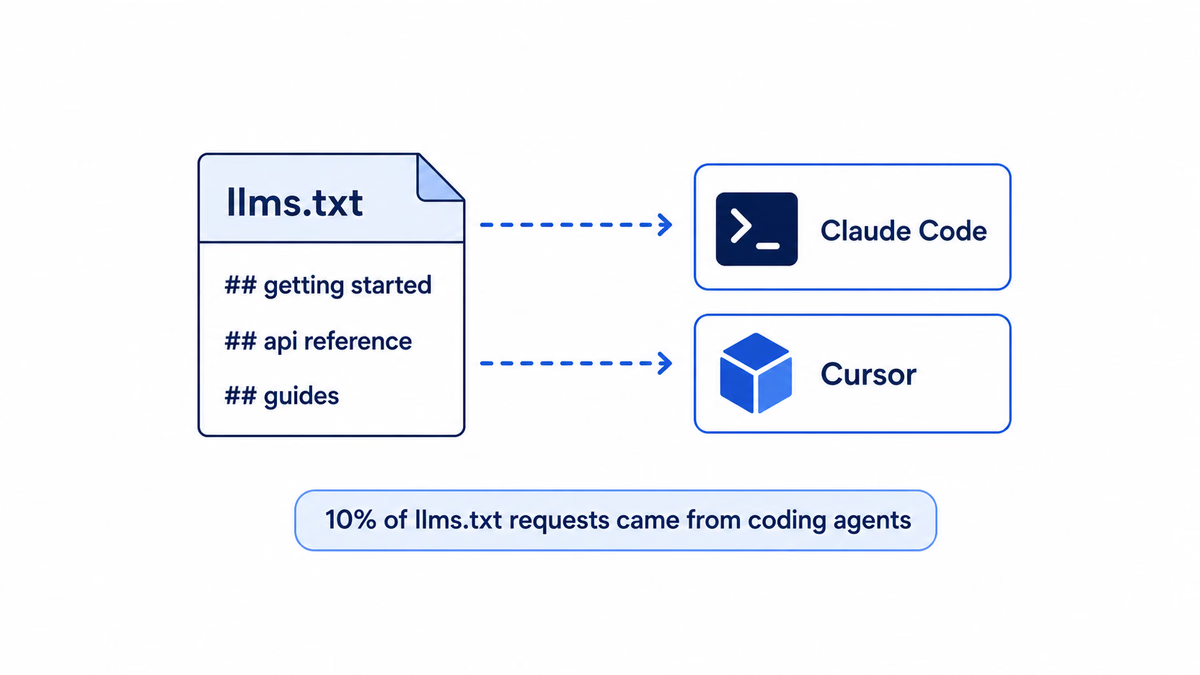
The real use case is narrower than the marketing suggests: coding agents and agentic browsers. When a developer asks Claude Code to work against your API, the agent needs to find your reference docs fast. An llms.txt file is a cheap signpost, which is why companies like Stripe and Vercel ship one. That coding-agent traffic (10% of the requests Ahrefs saw) is the one category with real evidence behind it.
That is a good reason to publish if you have a developer audience. It is not a reason to expect support deflection.
How AI clients actually reach your help center
There are three mechanisms, and they are not equivalent.
| Mechanism | How it works | Reliability |
|---|---|---|
| Crawling | The client fetches and parses your public HTML | Partial (depends on crawler and markup) |
| llms.txt | A static markdown index the client may or may not read | Limited (97% saw zero requests) |
| MCP server | Your knowledge base is exposed as a tool the client can query | Yes (the client requests it deliberately) |
The difference matters. Crawling and llms.txt are both hopeful: you publish, and something may read it. An MCP server is requested. When someone in Claude Desktop or Claude Code asks a question, the client queries your current documentation and gets an answer grounded in what you published this morning, not what a crawler cached last month. It also covers private content a crawler will never see.
Which platforms have an MCP server?
The more useful question is not who supports llms.txt, but who exposes a served connection an AI client can query. Most major platforms now ship one, at different stages of maturity.
| Platform | MCP server | llms.txt |
|---|---|---|
| HelpSite | Yes (higher plans) | Author it yourself |
| Document360 | Yes | Author it yourself |
| Notion | Yes | Author it yourself |
| Atlassian (Confluence) | Yes (GA Feb 2026) | Author it yourself |
| Zendesk | Early access | Author it yourself |
| Intercom | Beta (Fin Agent API) | Author it yourself |
MCP status is sourced from each vendor's public docs as of August 2026 (linked above); this space moves fast, so verify before you buy. "Author it yourself" means the platform does not generate the llms.txt file for you — you write the short markdown file by hand and host it. None of these tools produce it automatically, and whether you can host it at your site root depends on the platform's file access.
So should you publish one?
Yes, with calibrated expectations. It costs an hour, it will not hurt you, and it may help a developer's agent find your API reference. Keep it short, keep the links accurate, and regenerate it when your documentation structure changes. A stale llms.txt is worse than none.
But do not treat it as your AI strategy. What actually changes whether an assistant answers correctly about your product is more boring: whether your articles exist, whether they are current, whether each answers a single question plainly, and whether an AI client can retrieve them on demand.
- If you are a support lead: skip it and spend the hour reviewing what people actually searched for last week. Reviewing specific searches and conversations along with their sources in Analytics will change more answers than a static file.
- If you are a developer-relations or product team: publish it. Your audience uses coding agents daily, and this is the one case with real evidence behind it.
- If your team works in Claude: set up an MCP Server instead. It is requested rather than merely published.
- If you sell to security-conscious buyers: llms.txt exposes only public content. Private documentation reaches AI clients through an authenticated connection.
What about the answers customers see?
Whichever mechanism delivers your content, the trust question is the same: can the reader see where the answer came from?
Answers generated from your published articles with the source shown are designed to reduce the risk of confident but wrong responses, because a reader can check the citation. No approach removes that risk entirely. That is why Sourced AI Answers surfaces the article behind each response from HelpSite's AI Chatbot.
Frequently asked questions
Does llms.txt help SEO or AI Overviews?
No. Google states that Search ignores these files and they neither help nor hurt rankings. Treat any pitch selling llms.txt as a ranking factor with suspicion.
Is llms.txt the same as robots.txt?
No. robots.txt tells crawlers what they may access. llms.txt suggests what is worth reading. One sets permissions; the other makes a recommendation nothing is obligated to follow.
What is better than llms.txt for AI answers about my product?
A served connection. HelpSite's MCP Server lets Claude Desktop, Claude Code, and other MCP-compatible clients query your knowledge base directly, including private content, and always against your current articles.
How often should I update it?
Whenever your documentation structure changes. Broken links in an llms.txt file actively mislead the agents that do read it, so a stale file is worse than none.